Whether you work in the NHS, a Gulf hospital, or anywhere Arab patients walk through your door — MEDUMOND equips you to communicate safely and confidently.
Bridging Worlds · Healing Together
Culture can still break the consultation — even when your patient is fluent in English
Before misunderstanding turns into avoidable clinical risk, MEDUMOND equips healthcare professionals with the cultural competence, clinical communication skills, and practical medical Arabic needed to manage consultations with Arab patients safely. It helps you recognise the cultural expectations that can shape trust, consent, family involvement, privacy, dignity, and sensitive care.
Practical skills you can apply in your very next consultation.
- Recognise the cultural expectations that shape trust, consent, and family involvement in consultations with Arab patients.
- Communicate with confidence in the clinical scenarios that repeat every day — history-taking, consent, examination, and discharge.
- Use practical medical Arabic from day one — no prior Arabic needed.

Not language tutors.
Built by practising clinicians, not by a language school
Structured modules. Real clinical scenarios.
Each module can be taken independently — or combine them for the complete foundation.
From cultural understanding to confident clinical communication
Medical Clinical Communication & Cultural competence is a structured clinical programme built for healthcare professionals working with Arab patients. It combines two essential capabilities: understanding the cultural context behind the consultation, and knowing how to communicate effectively within it. The programme is built around real clinical encounters rather than classroom Arabic. The Essential Pathway consists of two independently valuable modules — Cultural Awareness and Clinical Communication — that together form the complete foundation for culturally informed clinical communication with Arab patients.
What You'll Be Able To
- Recognise the cultural expectations that shape trust, consent, and family involvement in consultations with Arab patients.
- Communicate with confidence in the clinical scenarios that repeat every day — history-taking, consent, examination, and discharge.
- Use practical medical Arabic from day one — no prior Arabic needed.
- Understand when a patient's words may carry cultural meaning beyond their translation.
- Reduce the risk of miscommunication that leads to complaints, delays, or cancelled care.
- Arrive culturally ready if you are relocating to the Gulf — for the hospital, the ward, and daily life.
- Build stronger rapport with Arab patients and their families from the very first interaction.
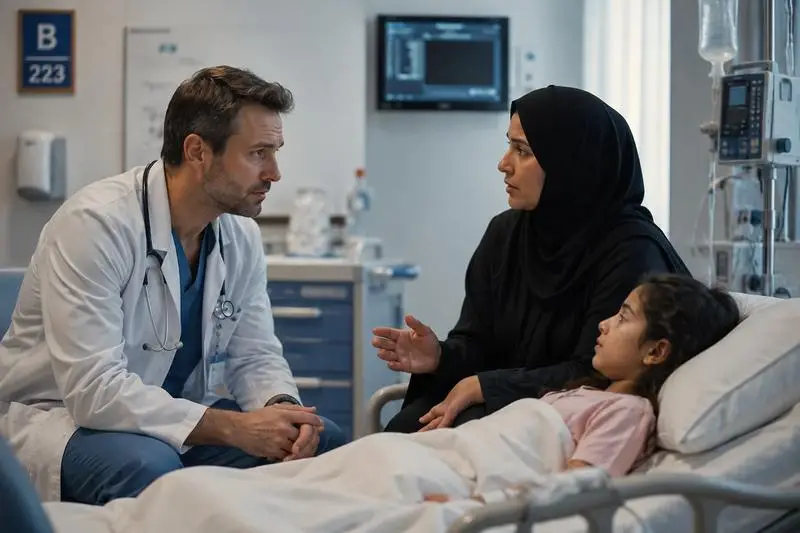
One correctly understood cultural cue transformed the clinical decision and the patient's journey.
When the words were right — and the meaning was lost
An Arab mother sat beside her daughter's bed. The child was scheduled for surgery and had been fasting for six hours. It was the sixth time in two years that the procedure had been scheduled.
When the anaesthetist asked for consent, the mother said, “I don't understand.” An interpreter was present and translated her words accurately. But the anaesthetist understood the response as a refusal and prepared to cancel the case.
A nearby Arabic-speaking doctor heard what had happened and gently asked the mother, “What is it you don't understand?”
She did not mean she refused. She could not understand why her daughter's surgery had been scheduled repeatedly over the previous two years. The interpreter had translated her words. The concern behind them had not been heard.
The doctor explained the underlying reason would be addressed fully after the procedure. Reassured, the mother gave consent. The surgery went ahead.
This is the gap MEDUMOND addresses. Not replacing the interpreter. Not teaching Arabic as a language course. Training healthcare professionals to recognise the cultural meaning behind what Arab patients and families say — especially when a seemingly simple phrase can change a clinical decision. Because understanding the words is not always the same as understanding the patient.
Transparent individual pricing. Group options available.
Cultural Awareness
Join the waitlist now. Waitlist members are notified first when registration opens and receive an extended 4-week WhatsApp support period (standard: 2 weeks).
- Cultural Awareness
- Clinical Communication
- Family Relocation
Clinical Communication
Join the waitlist now. Waitlist members are notified first when registration opens and receive an extended 4-week WhatsApp support period (standard: 2 weeks).
- Cultural Awareness
- Clinical Communication
- Family Relocation
Essential Pathway
Join the waitlist now. Waitlist members are notified first when registration opens and receive an extended 4-week WhatsApp support period (standard: 2 weeks).
- Cultural Awareness
- Clinical Communication
- Family Relocation
Family Relocation
Join the waitlist now. Waitlist members are notified first when registration opens and receive an extended 4-week WhatsApp support period (standard: 2 weeks).
- Cultural Awareness
- Clinical Communication
- Family Relocation
Built around your working week — not against it.
From recorded modules to live sessions to ongoing support. The full pathway, on your schedule.
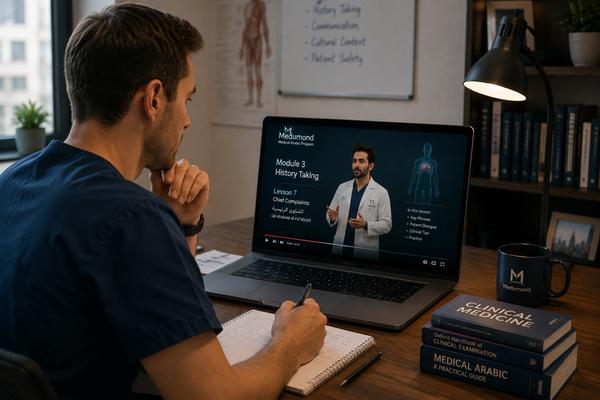
Watch Recorded Modules
Each module opens with recorded content covering the most important daily clinical scenarios in Arabic. Every scenario is presented in Arabic, with English transliteration, English translation, and phonics support. Replay any section. No prior Arabic reading skills required.
A correctly translated sentence can still be a patient-safety failure.
Cultural misreading — not just language — drives communication failure with Arab patients. The cost falls on patients, clinicians, and the organisations that employ them. The intervention is structured training.
Logged in a single year across 69 facilities — highest in emergency, surgical, and medical-surgical settings.
Professional translations contained clinically significant errors in 8.3% of cases. Google Translate in 23.3%. ChatGPT rose to 33.3%. One in three is untenable in clinical care.
Interpreter-mediated consultations can add time pressure and make rapport-building more difficult, affecting the clinician's ability to obtain a complete patient history.
MEDUMOND and Professional Interpretation
What MEDUMOND does is strengthen clinician-led communication at the point of care — reducing everyday dependence on interpreters, particularly in emergency and basic clinical interactions. When a clinician can greet a patient in Arabic, take a basic history, or explain a procedure without waiting for an interpreter to become available, the consultation moves faster and the patient feels more seen.
The interpreter is a bridge for formal exchanges. MEDUMOND is the clinician's own voice for the rest. Together they close the gap that neither can close alone.
In practice, this means interpreters are used more effectively — reserved for the moments that genuinely require formal translation rather than being called in for every interaction. That is better for patients, better for clinicians, and better for the services that provide interpreter support.
MEDUMOND does not replace the professional interpreter. Interpreter services remain essential for formal translation, complex legal or high-risk exchanges, and situations where precise documented consent is required.
Built by clinicians who have been the person asked to bridge the gap.
The curriculum is built around what clinicians actually need to say on wards, in clinic, and on-call — not around textbook dialogues or generic language exercises.
Dr Wafaa Saleh
FounderFounder & Lead Instructor
Plastic Surgeon based in the UK, medical educator, ATLS instructor, and Certified Medical Interpreter (Arabic) with around 20 years of experience teaching clinical Arabic communication to healthcare professionals.
Her dual perspective as both clinician and interpreter is central to MEDUMOND's identity. She understands what is at stake when communication fails — because she has been the person asked to bridge the gap.
Prof Amr Maghazy
Scientific ReviewerScientific Reviewer
Emeritus Professor of Plastic Surgery with affiliation to the Université de Bordeaux, with around 40 years of medical teaching and clinical practice. Certified Medical Interpreter (Arabic).
His role is to ensure that every clinical scenario in the MEDUMOND curriculum meets the standards expected of formal medical education — and that the communication frameworks taught are clinically valid across the specialties the programme serves.
“We did not build a language programme. We built a clinical communication programme — because that is what patient care actually requires.”
— Dr Wafaa Saleh, Founder, MEDUMOND
From patient safety to daily practice — the feedback is consistent.
"This is not a language course — it is a clinical communication course. Exactly what we needed."
Participant Feedback Snapshot
From early workshop surveys. Strong enthusiasm, high relevance to practice, and clear interest in a structured multi-session pathway.
We partner with organisations that support non-Arabic-speaking clinicians caring for Arab patients — through relocation, recruitment, training, or clinical services.
Flexible collaboration models for organisations whose healthcare professionals care for Arab patients.
Strategic Partner
Does your organisation places or trains clinicians who work with Arab patients?. We should talk.
We partner with any organisation — globally — where Healthcare Professionals work with Arab patients.
The structure is entirely up to you:
- Referral arrangement
- Revenue share or commission
- Bundled into your existing package or offering
- Co-branded or white-label access
One conversation is enough to know if there's a fit.
Fill in the form — one conversation is enoughPartner types we work with
The questions clinicians ask before they book.
Short answers. If yours is not here, the Programme Consultation is the right place to ask.
Still have a question? Email us directly — we reply within one business day.
contact@medumond.comRegister Your Interest
Whether you are an individual clinician, part of a healthcare organisation, or exploring a strategic partnership — we would love to hear from you.
A recommendation on which pathway fits, and what the timeline looks like.
A clear answer on cost, scheduling, and next steps.
Cohort spaces per specialty are limited to 4 participants. Prefer email? contact@medumond.com
Your information is handled in accordance with our . We will not share your details with third parties.